Hamamatsu strengthens CMOS imaging capabilities with Fairchild technologies

The addition of Fairchild Imaging's advanced CMOS sensor technologies enhances Hamamatsu's ability to support low-noise, high-resolution imaging across medical, scientific, industrial and space applications.
Following the Group's acquisition of Fairchild Imaging in 2024, Hamamatsu Photonics Europe is now promoting the company's advanced CMOS image sensor technologies to customers across Europe. The addition widens the range of applications Hamamatsu can support, adding expertise in high-performance CMOS image sensors for demanding X-ray, medical, scientific, space-qualified and other advanced imaging settings.
Fairchild Imaging's technologies address challenging imaging requirements such as low-noise performance, high resolution and a range of pixel sizes. The accompanying technical support and application knowledge complement Hamamatsu's existing CMOS technologies, its wider photonics portfolio and its European customer support network.
Offering Fairchild Imaging technologies to European customers
Hamamatsu Photonics Europe is broadening its advanced imaging offering by actively promoting Fairchild Imaging's CMOS image sensor technologies to European customers.
Founded in 1920 and now a Hamamatsu Photonics company, Fairchild Imaging develops CMOS image sensors for the most demanding imaging applications. Its technologies complement Hamamatsu's existing photonics portfolio and extend the imaging capabilities available to customers operating in the most technically challenging environments.
Supporting demanding imaging applications
Advanced imaging applications typically call for a careful balance of sensitivity, resolution, noise performance, speed and reliability. By integrating Fairchild Imaging technologies, Hamamatsu can now offer customers exceptionally low noise of 0.25 e⁻ RMS, allowing imaging deeper into the low photon regime, including down to single-photon counting. This is combined with high dynamic range achieved through a proprietary dual-gain architecture.
The main application areas are X-ray imaging, medical imaging, scientific imaging and space-related imaging, where CMOS sensor performance is important in enabling precise and reliable image acquisition.
A broader portfolio of CMOS sensor capabilities
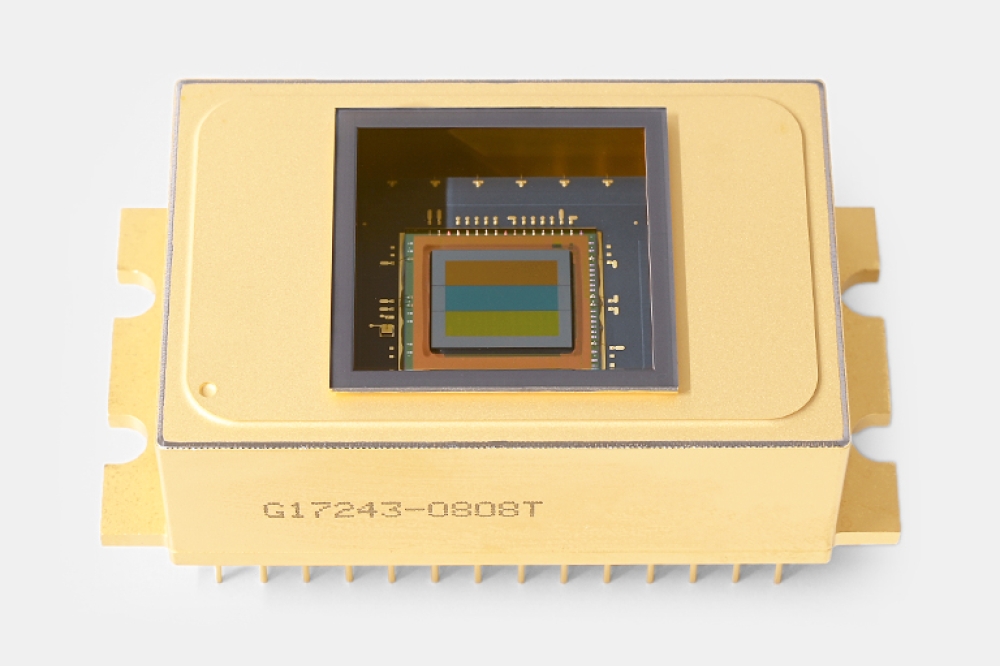
Fairchild Imaging brings expertise in advanced CMOS image sensor design, including technologies suited to low-light and challenging imaging conditions. This strengthens Hamamatsu's ability to support customers from component selection and custom sensor development through to integration into advanced imaging systems. The expanded portfolio takes in CMOS sensors for X-ray imaging, medical imaging and space-qualified applications, as well as scope for custom advanced sensor development tailored to particular requirements.
Key example products include:
- F40 detector for X-ray imaging: high resolution, wide dynamic range, compact form factor, USB 3.0.
- F3D detector for medical imaging: high resolution, high speed, low dose.
- HWK4123 for space imaging: exceptional fidelity in 4K, 4/3", 10.5MP, BSI, sCMOS 3.1 technology.
- CIS2521 for space imaging: TRL-9 workhorse 5.5MP sCMOS sensor for high-reliability space-qualified imaging.
Expanding application reach through advanced CMOS sensor expertise
With the addition of Fairchild Imaging, Hamamatsu is extending the range of application requirements it can meet with advanced CMOS image sensor technologies. Fairchild Imaging's experience in space applications, together with its high-resolution CMOS sensor technologies for X-ray and medical imaging, strengthens Hamamatsu's ability to support customers working at the limits of imaging performance.
This expanded capability is particularly relevant where image quality, reliability and application-specific sensor design are critical.
Ljiljana Durdevic, Technology and Market Expert at Hamamatsu Photonics Europe, said Fairchild Imaging's CMOS sensor technologies were a strong complement to Hamamatsu's existing image sensor portfolio. By actively introducing these capabilities to customers across Europe, she added, the company could support a wider range of demanding imaging applications, including space-qualified imaging, X-ray imaging, medical imaging and other high-performance settings where sensor quality and reliability are critical.